To delete a PowerPoint file on Windows, close the presentation, open File Explorer, find the file (it ends in .pptx or .ppt), then right-click it and select Delete, or select it and press the Delete key. The file goes to the Recycle Bin, so you can still get it back until you empty the bin. If you only want a presentation off PowerPoint’s Recent list, right-click it there and choose Remove from list, not Delete file.
This guide covers deleting presentations safely on Windows and Mac, what happens when the file lives in OneDrive or is shared, how to restore something you deleted by mistake, how to clean up PowerPoint’s Recent list, and a few ways to declutter inside a presentation without deleting it.
Which do you need?
| You want to | Do this |
|---|---|
| Get rid of a presentation file | Delete it in File Explorer or Finder |
| Remove a file stored in OneDrive | Delete it, knowing it disappears from every synced device |
| Hide a file from PowerPoint’s start screen | Recent list > Remove from list |
| Clear the whole Recent list | File > Open, then clear unpinned items |
| Keep the file but make it smaller or cleaner | Delete unused layouts, compress pictures, Inspect Document |
| Remove the PowerPoint app itself | Uninstall Microsoft 365 or Office |
Before you delete anything
- Close the presentation. Windows won’t delete a file that’s open in PowerPoint. Close it, and if you still get a “file in use” message, close PowerPoint completely.
- Check you have the right file. Open it once, or look at the date modified, especially if you have several versions with similar names.
- Think about shared copies. If you shared the file from OneDrive or SharePoint, deleting it can remove it for everyone (more on that below).
- Keep a backup of anything you might need. Copy it to an external drive or another folder first.
Delete a PowerPoint file in Windows
- Open File Explorer (press Windows + E).
- Go to the folder that holds the presentation. If you don’t know where it is, type the file name or .pptx in the search box at the top right of File Explorer.
- Select the file. To pick several, hold Ctrl and click each one.
- Right-click and select Delete, or press the Delete key. You can also drag the file onto the Recycle Bin.
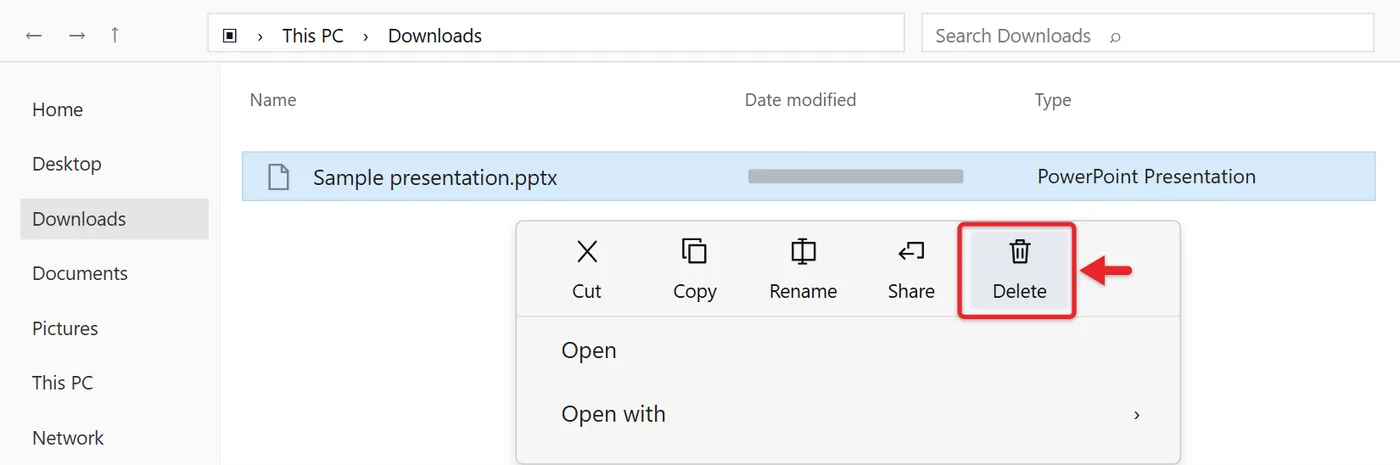
The file moves to the Recycle Bin. It still takes up space until you empty the bin, and you can restore it until then.
Delete permanently
Press Shift + Delete instead of Delete to skip the Recycle Bin. Windows asks you to confirm, and the file is gone for good, so use this only when you’re sure. Emptying the Recycle Bin has the same effect on everything in it.
Delete a PowerPoint file on a Mac
In Finder, find the presentation, then drag it to the Trash in the Dock, or right-click it and choose the option to move it to the Trash (called the Bin in some regions). Like the Windows Recycle Bin, the Trash keeps the file until you empty it, so you can drag it back out if you change your mind.
Restore a presentation you deleted by mistake
On Windows, open Recycle Bin from the desktop, find the file, then right-click it and choose the restore option. It returns to the folder it was deleted from. On a Mac, open the Trash and move the file back to a folder.
If you emptied the bin or used Shift + Delete, the file can’t be restored from there. Check any backups you have, and if the file was in OneDrive, check OneDrive’s own recycle bin.
Deleting files stored in OneDrive or SharePoint
If you save presentations to OneDrive, delete works differently. Microsoft’s guide to deleting files or folders in OneDrive explains the key points:
- You can delete a file from the OneDrive folder in File Explorer with the Delete key, just like any other file.
- Deleting a file from your OneDrive folder removes it from both OneDrive and your PC. Because OneDrive syncs, it also disappears from your other synced devices.
- If the file is shared, deleting it deletes it for everyone you shared it with.
- To keep a copy on this PC only, move the file out of the OneDrive folder instead of deleting it.
- To keep the file in the cloud but free up space on your PC, use Files On-Demand rather than deleting.
Restore from the OneDrive recycle bin
Microsoft’s page on how to restore deleted files or folders in OneDrive gives these steps:
- Go to onedrive.com and sign in.
- Select Recycle bin.
- Select the presentation and choose Restore.
Microsoft says deleted items stay in the recycle bin for 30 days with a personal account and 93 days with a work or school account, unless an administrator changed that. Once an item is permanently deleted from the OneDrive recycle bin, it can’t be restored.
Remove presentations from PowerPoint’s Recent list
Often you don’t want the file gone; you just don’t want it showing on PowerPoint’s start screen. Microsoft’s guide to customizing the list of recently used files covers these options for PowerPoint for Microsoft 365, 2024 and 2021 on Windows.
Remove one file
- Open PowerPoint and find the file in the Recent list on the start screen, or under File > Open.
- Right-click it and select Remove from list.
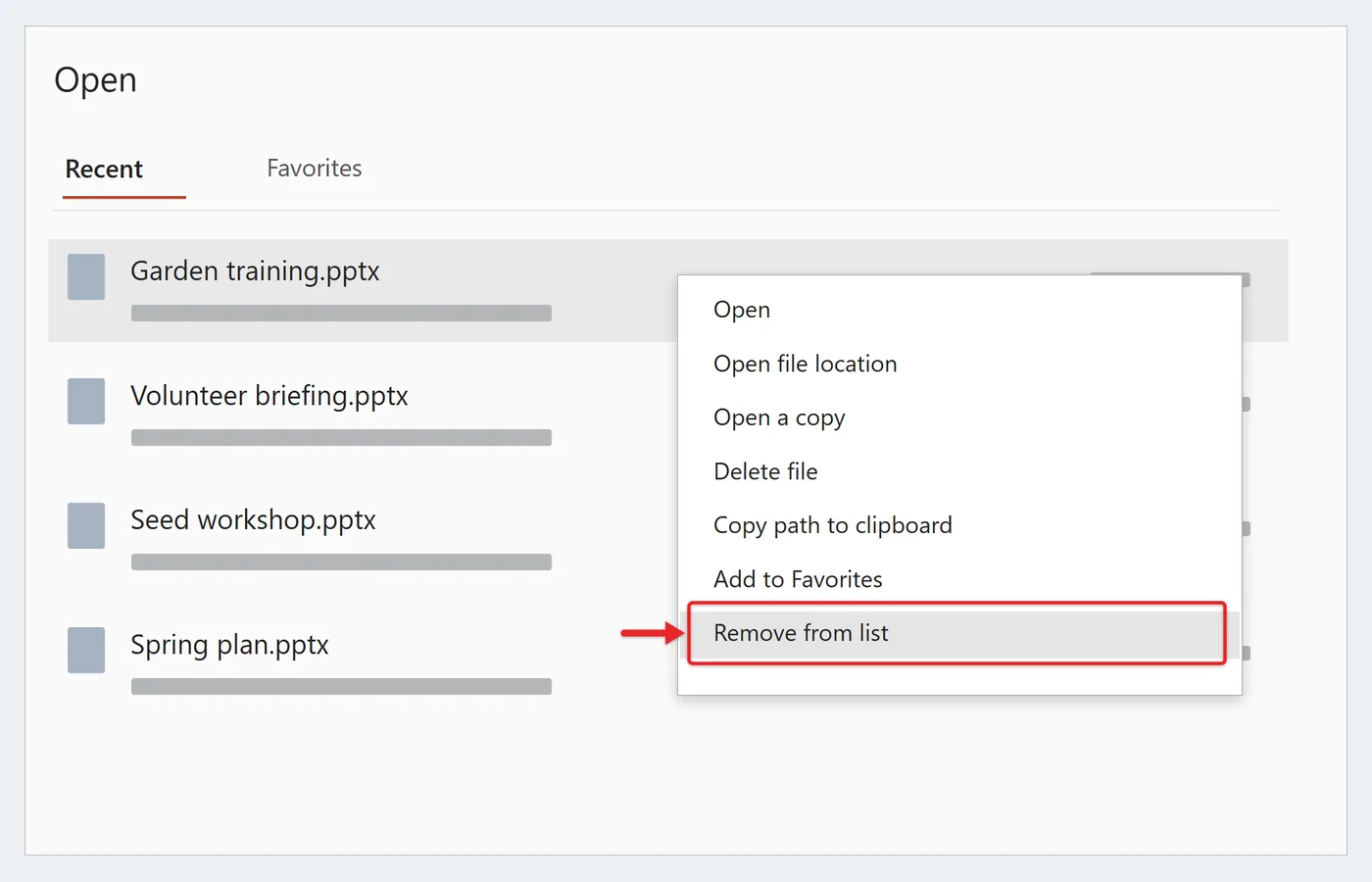
Be careful here. The same menu has Delete file, and Microsoft warns that it removes the file from your system, not just from the list.
Clear the whole list
- Select File > Open.
- Right-click any file in the Recent list and choose the option to clear unpinned items (Microsoft’s page shows it as Clear unpinned Documents; PowerPoint’s wording may differ).
- Select Yes to confirm.
Files you’ve pinned or added to favorites stay on the list. In Microsoft 365 you can right-click a file and select Add to Favorites to keep it there; older versions use Pin this item to the list.
Stop showing recent files
Go to File > Options > Advanced and scroll to Display. Set the number of recent files to show to 0. The exact wording of this setting may differ in PowerPoint.
File Explorer’s Recent list
Presentations can also show in the Recent or Home section of File Explorer. Right-click the item there and look for the option to remove it from Recent. The label depends on your version of Windows. Like the PowerPoint option, this hides the shortcut and leaves the file where it is.
Declutter inside a presentation
If the real problem is a bloated or messy file, you can clean it up instead of deleting it. Save a copy first.
Delete unused slide layouts
Open Slide Master view. In the thumbnail pane, right-click a layout you don’t use and select Delete Layout, or select it and press Delete. Microsoft’s article on deleting a slide layout notes that you can’t delete a layout that any slide is using.
Shrink pictures
Microsoft’s guide to reducing the file size of your PowerPoint presentations suggests:
- Select a picture, then Picture Format > Adjust > Compress Pictures.
- Clear Apply only to this picture to compress them all.
- Tick Delete cropped areas of pictures (cropped parts can’t be restored afterward) and choose Use default resolution or a lower option.
Under File > Options > Advanced > Image Size and Quality, you can also turn on Discard editing data, keep Do not compress images in file cleared, and set Default resolution to 150 ppi or lower. If you embed fonts under File > Options > Save, choosing Embed only the characters used in the presentation keeps the file smaller.
Remove hidden personal data
Before sharing, use Document Inspector to strip comments, document properties and personal information. Microsoft’s guide to removing personal information from your presentation gives these steps:
- Select File > Info > Check for Issues > Inspect Document.
- Select Inspect.
- Next to each type of content you want gone, select Remove All.
- Select Reinspect to check, then Close.
Microsoft notes that removed data can’t always be restored, which is why a saved copy matters.
Unsaved and AutoRecover files
PowerPoint keeps temporary copies of presentations you didn’t save. To see them, open a presentation and go to File > Info > Manage Document > Recover Unsaved Presentations, as described in Microsoft’s guide to recovering an earlier version of an Office file. Open any you want to keep and save them properly.
AutoRecover files are stored in the folder shown under File > Options > Save > AutoRecover File Location. Microsoft’s recover your PowerPoint files page gives the default as C:\Users\<username>\AppData\Roaming\Microsoft\PowerPoint. Leave these alone while PowerPoint is open, since they’re your safety net if it crashes.
Meant the PowerPoint app?
If you want to remove PowerPoint itself, Microsoft’s guide to uninstalling Office from a PC says that in most cases you can’t uninstall one app that’s part of a Microsoft 365 suite, so you’d remove the whole suite. On Windows 11, go to Settings > Apps > Installed apps, select the three dots next to Microsoft 365 or Office, and choose Uninstall. Microsoft’s page also gives a Control Panel route through Programs and Features. Microsoft adds that uninstalling doesn’t remove the files you created, so your presentations stay put.
Common problems
- File is open error. If Windows says the action can’t be completed because the file is open, close the presentation and PowerPoint, then try again. Restart the PC if it persists.
- The file came back after I deleted it. It may be syncing from OneDrive or another device. Delete it from onedrive.com, or check that you deleted the copy in the OneDrive folder, not a separate local copy.
- I deleted a shared file and others lost it. Restore it from the OneDrive recycle bin within the retention period.
- A deleted file still shows on PowerPoint’s start screen. That’s just the Recent list remembering it. Use Remove from list.
- No permission to delete. The file may be on a work share or in a folder you don’t own. Ask the owner or your IT team.
Questions
Does removing a file from PowerPoint’s Recent list delete it?
No. Remove from list only hides it from the list. The file stays where it is. Delete file on the same menu does delete it.
Can I get back a PowerPoint file I deleted?
Usually, if you act quickly. Check the Recycle Bin or Trash first, then the OneDrive recycle bin, which keeps files for 30 days on personal accounts and 93 days on work or school accounts.
Does deleting a presentation free up space?
Not until it leaves the Recycle Bin or Trash. Empty the bin, or use Shift + Delete on Windows, to reclaim the space.

Matt Williams is the writer and editor behind TechInfoHome. He holds a degree in computer science and has more than 10 years of experience working in IT. For the past 5 years he has written online tutorials for Windows, Microsoft Office, Google apps and iPhone, with a focus on clear steps that get readers to a working fix quickly.